


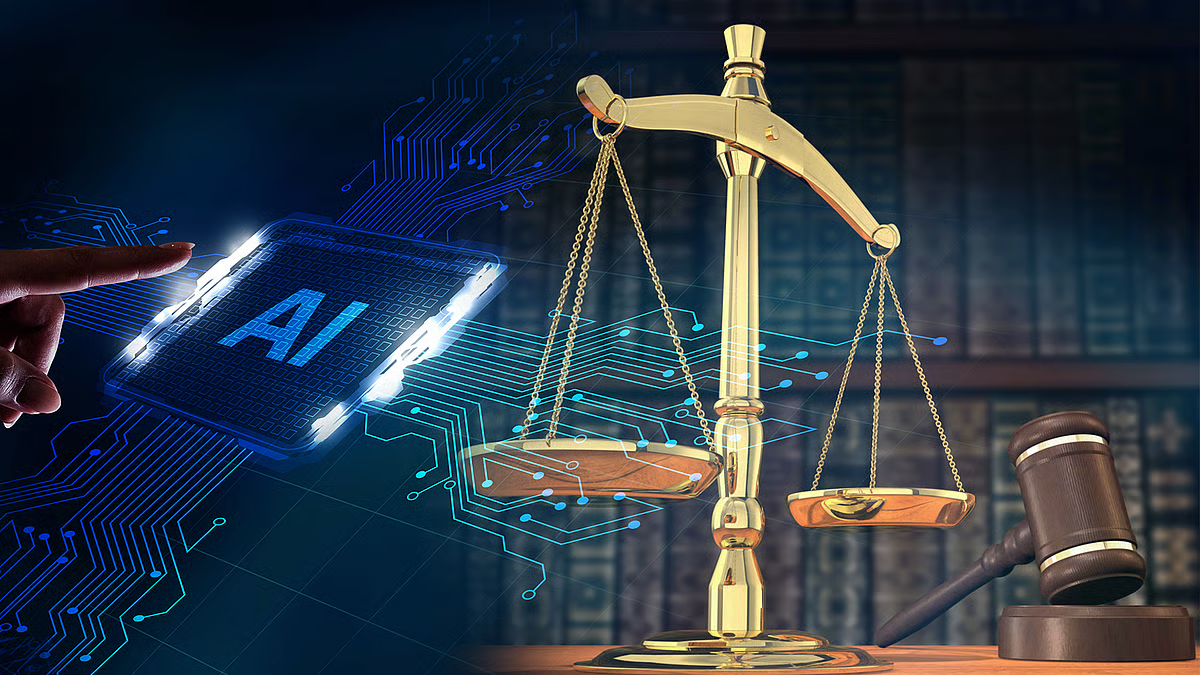
India's courts are turning to artificial intelligence to tackle one of the world's heaviest judicial backlogs. From digital research assistants to real-time transcription and translation, AI is moving from experiment to everyday infrastructure & helping lawyers, judges and litigants navigate a system burdened by scale.
The numbers are stark. District courts carry more than 40 million pending matters, High Courts another 6.2 million, and the Supreme Court of India has over 90,000. Delays grow from procedural errors, adjournments and documentation gaps. For legal professionals, this means hours lost to manual search and repetitive tasks.
AI promises to convert backlog into bandwidth.
At SCC Online, a new conversational research assistant built on Microsoft’s cloud stack allows even junior lawyers to ask complex legal questions in plain language and receive cited, contextual answers. With access to millions of judgments across hundreds of databases, the platform reduces research that once took days into minutes. Accuracy safeguards remain central: responses are source-linked and data stays within controlled environments.
Private practice is seeing similar change. At Trilegal, AI tools are embedded into daily workflows—from drafting and summarizing to predictive insights across matters. Lawyers use secure copilots grounded in internal repositories, while analytics platforms offer near real-time visibility into caseloads and risk. Routine extraction from bulky files, once an evening-long chore, is now automated.
For the firm’s technology leadership, adoption has been cultural as much as technical. As professionals experienced time savings, usage spread organically. AI became, in their words, an “invisible colleague”—present everywhere, deciding nothing.
Beyond elite firms, the implications are broader.
Language remains one of India’s biggest barriers to justice. Although most higher-court judgments are written in English, only a fraction of citizens are comfortable reading it. AI systems are now translating orders into multiple Indian languages and making legislation searchable for non-English speakers.
India’s courts are turning to artificial intelligence to tackle one of the world’s heaviest judicial backlogs. From digital research assistants to real-time transcription and translation, AI is moving from experiment to everyday infrastructure—helping lawyers, judges and litigants navigate a system burdened by scale.
The numbers are stark. District courts carry more than 40 million pending matters, High Courts another 6.2 million, and the Supreme Court of India has over 90,000. Delays grow from procedural errors, adjournments and documentation gaps. For legal professionals, this means hours lost to manual search and repetitive tasks.
AI promises to convert backlog into bandwidth.
At SCC Online, a new conversational research assistant built on Microsoft’s cloud stack allows even junior lawyers to ask complex legal questions in plain language and receive cited, contextual answers. With access to millions of judgments across hundreds of databases, the platform reduces research that once took days into minutes. Accuracy safeguards remain central: responses are source-linked and data stays within controlled environments.
Private practice is seeing similar change. At Trilegal, AI tools are embedded into daily workflows—from drafting and summarizing to predictive insights across matters. Lawyers use secure copilots grounded in internal repositories, while analytics platforms offer near real-time visibility into caseloads and risk. Routine extraction from bulky files, once an evening-long chore, is now automated.
For the firm’s technology leadership, adoption has been cultural as much as technical. As professionals experienced time savings, usage spread organically. AI became, in their words, an “invisible colleague”—present everywhere, deciding nothing.
Beyond elite firms, the implications are broader.
Language remains one of India’s biggest barriers to justice. Although most higher-court judgments are written in English, only a fraction of citizens are comfortable reading it. AI systems are now translating orders into multiple Indian languages and making legislation searchable for non-English speakers.
India’s courts are turning to artificial intelligence to tackle one of the world’s heaviest judicial backlogs. From digital research assistants to real-time transcription and translation, AI is moving from experiment to everyday infrastructure—helping lawyers, judges and litigants navigate a system burdened by scale.
The numbers are stark. District courts carry more than 40 million pending matters, High Courts another 6.2 million, and the Supreme Court of India has over 90,000. Delays grow from procedural errors, adjournments and documentation gaps. For legal professionals, this means hours lost to manual search and repetitive tasks.
AI promises to convert backlog into bandwidth.
At SCC Online, a new conversational research assistant built on Microsoft’s cloud stack allows even junior lawyers to ask complex legal questions in plain language and receive cited, contextual answers. With access to millions of judgments across hundreds of databases, the platform reduces research that once took days into minutes. Accuracy safeguards remain central: responses are source-linked and data stays within controlled environments.
Private practice is seeing similar change. At Trilegal, AI tools are embedded into daily workflows—from drafting and summarizing to predictive insights across matters. Lawyers use secure copilots grounded in internal repositories, while analytics platforms offer near real-time visibility into caseloads and risk. Routine extraction from bulky files, once an evening-long chore, is now automated.
For the firm’s technology leadership, adoption has been cultural as much as technical. As professionals experienced time savings, usage spread organically. AI became, in their words, an “invisible colleague”—present everywhere, deciding nothing.
Beyond elite firms, the implications are broader.
Language remains one of India’s biggest barriers to justice. Although most higher-court judgments are written in English, only a fraction of citizens are comfortable reading it. AI systems are now translating orders into multiple Indian languages and making legislation searchable for non-English speakers.