India Paves the Way: Indigenous Bio-Bitumen Signals a Green Turning Point for Highways
India has entered a new chapter in sustainable infrastructure by becoming the world’s first country to commercially produce indigenous bio-bitumen for highway construction. Announced in early January 2026, this breakthrough replaces a portion of conventional petroleum-based bitumen with a bio-derived alternative made from agricultural residue. Beyond technological novelty, the development represents a strategic convergence of environmental responsibility, energy security, and rural value creation—closely aligned with national visions such as Viksit Bharat 2047 and Atma Nirbhar Bharat.
Understanding Bio-Bitumen: A Greener Binder for Roads
Bio-bitumen is a renewable binding material developed from biomass rather than crude oil. In the Indian innovation, agricultural waste such as rice straw, wheat stubble, and other farm residues undergoes a thermochemical process called pyrolysis. During this process, lignin—a naturally occurring polymer in plant cell walls—is converted into a viscous, carbon-rich substance that closely mimics the performance characteristics of conventional bitumen.
Developed jointly by CSIR–Central Road Research Institute (CRRI) and CSIR–Indian Institute of Petroleum (IIP), the technology enables up to 15 percent blending of bio-bitumen with fossil-derived bitumen without compromising road strength or durability. Patents have been filed, and the technology has already been transferred to industry partners for scale-up.
Performance and Environmental Outcomes: Proof from the Ground
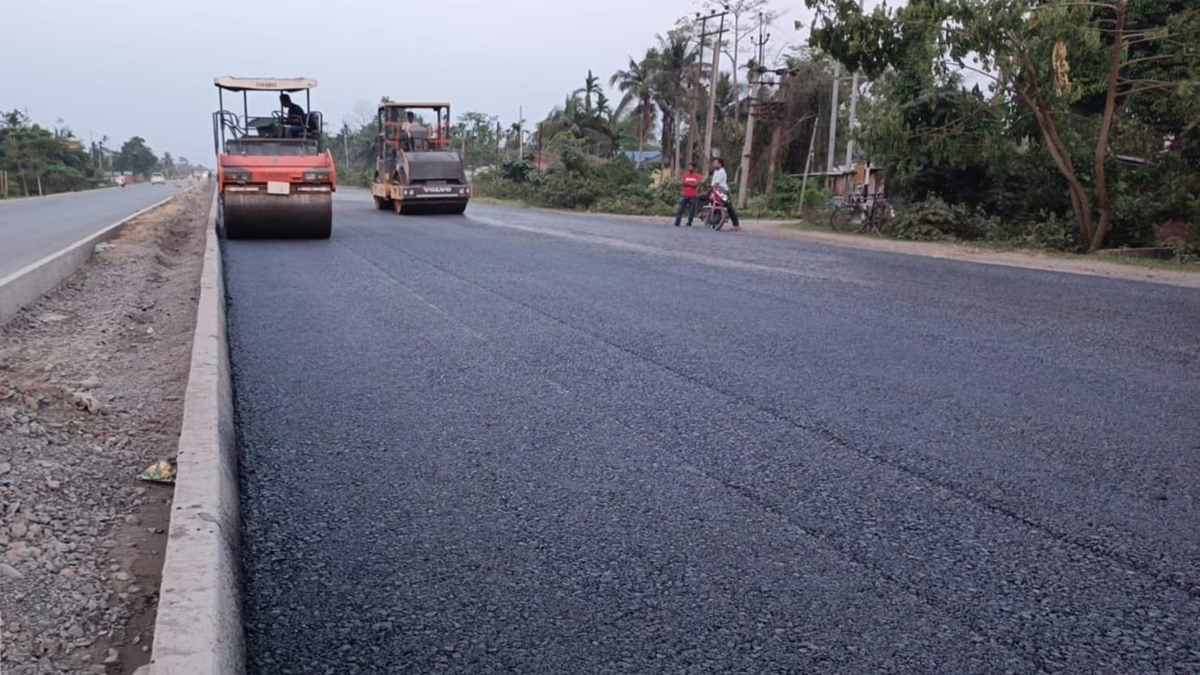
Field trials have demonstrated that bio-bitumen blended roads perform on par with traditional highways. Pilot stretches—including a 100-metre test section on the Jorabat–Shillong Expressway (NH-40) in Meghalaya and a one-kilometre road segment in Nagpur—have shown satisfactory mechanical strength and resistance to wear.
The environmental gains, however, are far more significant. Bio-bitumen reduces greenhouse gas emissions by at least 70 percent compared to petroleum bitumen. Crucially, it offers a productive alternative to stubble burning, a major contributor to air pollution in northern India. By converting waste into infrastructure input, the innovation strengthens India’s circular economy framework while cutting dependence on fossil fuels.
Agricultural Residue Requirement for 15 Percent Blending: A Quantitative Analysis
India’s annual bitumen consumption is estimated at around 100 lakh tonnes (10 million tonnes), nearly half of which is imported. Achieving a 15 percent blending target would require approximately 15 lakh tonnes (1.5 million tonnes) of bio-bitumen each year.
Bio-bitumen production through pyrolysis typically yields about 10–20 percent output from agricultural biomass, depending on feedstock quality and process efficiency. Based on this range, producing 1.5 million tonnes of bio-bitumen would require roughly 7.5 to 15 million tonnes of agricultural residue annually.
This requirement is well within India’s capacity. The country generates over 500 million tonnes of crop residue each year, with an estimated surplus of 100–150 million tonnes after agricultural reuse. Even at the upper estimate, bio-bitumen production would utilize only a fraction of available surplus, making large-scale adoption both feasible and sustainable.
Economic and Strategic Implications
From an economic standpoint, 15 percent bio-bitumen blending could save ₹4,000–4,500 crore annually in foreign exchange, while full-scale adoption holds the potential to offset ₹25,000–30,000 crore in bitumen imports. The model also opens new revenue streams for bio-refineries and provides farmers with an incentive to monetize agricultural waste.
Strategically, the initiative strengthens India’s leadership in bio-based materials and positions the country as a potential exporter of green road technologies at a time when global infrastructure is under pressure to decarbonize.
From Waste to World Leadership
India’s indigenous bio-bitumen is more than a material innovation—it is a systems-level solution linking climate action, rural livelihoods, and national self-reliance. With abundant biomass, proven technology, and supportive policy signals, India is uniquely positioned to scale this solution rapidly. If implemented effectively, bio-bitumen could transform highways into symbols of sustainable growth, turning farm waste into the foundation of future-ready infrastructure.