
Faceoff Technologies (FO AI) Extends Protection to the Most Vulnerable: Women and Children
Introducing FaceOff Technologies: India's Homegrown DeepTech Company Redefining Digital Trust in the AI Era.
The threats FO AI is built to counter — deepfakes, voice clones, and synthetic identities — don't affect all users equally. Women and children face specific, disproportionate risks from this technology, and FO AI's multi-signal approach is particularly suited to addressing them.
USP of Adoptive Cognitive Engine( ACE ) is Different
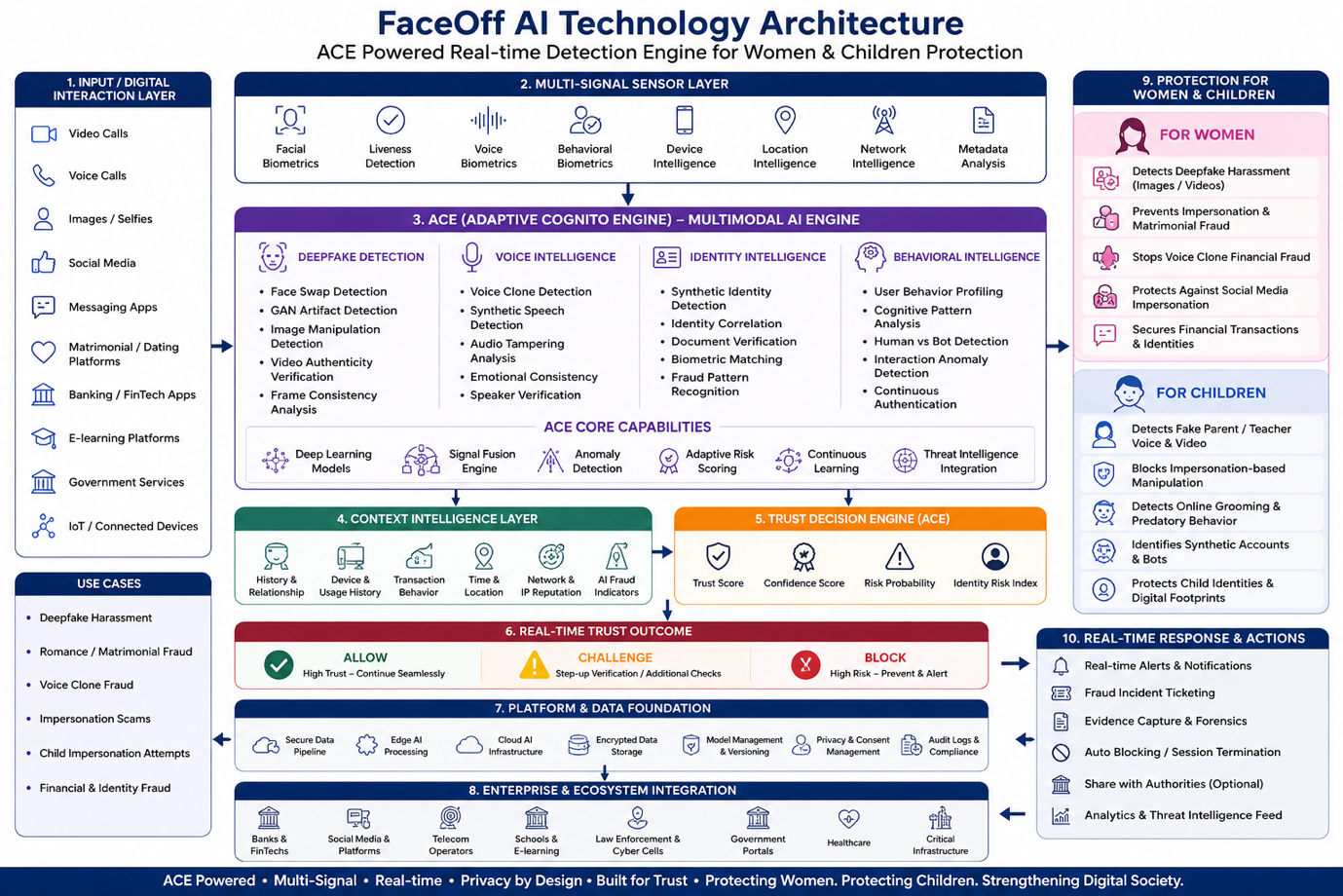
Unlike conventional fraud detection that reacts after an attack, FaceOff's Adaptive Cognito Engine (ACE) continuously analyzes facial, voice, behavioral, contextual, and physiological signals to establish trust before an interaction is completed. This infrastructure-first approach shifts the burden of detecting deception away from women and children and onto the technology itself, enabling real-time prevention of deepfake-enabled harassment, impersonation, synthetic identity fraud, and AI-generated scams while strengthening digital trust across platforms, institutions, and critical services.
For women: countering impersonation, harassment, and fraud
Women are frequently targeted by non-consensual deepfake content — manipulated images or videos used for harassment, extortion, or reputational harm. FO AI's deepfake detection layer, combined with facial biometrics and behavioral analytics, can flag synthetically altered media before it's used to intimidate or coerce, giving platforms and enforcement agencies a technical basis to act rather than relying on victims to prove manipulation after the fact.
Voice cloning adds another dimension: scammers increasingly clone a family member's or colleague's voice to manufacture urgency — a fake distress call, a supposed kidnapping, an emergency wire transfer request. FO AI's synthetic voice and audio tone analysis are designed to catch these cloned-voice patterns in real time, before money changes hands or panic drives a bad decision.
In matrimonial and romance fraud — a well-documented vector targeting women on dating and matchmaking platforms — synthetic identity detection and contextual risk scoring can flag fabricated profiles built from AI-generated faces and scripted personas, before trust is established and exploited.
For children: guarding against impersonation-based manipulation
Children are especially vulnerable to scams built on impersonation rather than direct contact — a cloned parent's or teacher's voice, a fabricated video call, a fake "school" or "official" communication designed to extract money, information, or compliance. FO AI's combination of deepfake detection, synthetic voice analysis, and behavioral biometrics is designed to catch exactly this pattern: media or calls that mimic a trusted figure but fail authenticity checks invisible to a child in the moment.
Contextual risk analysis also matters at the platform level — detecting unusual synthetic-identity activity or scripted, bot-like behavioral patterns that don't match a genuine account, which is often how predatory or fraudulent actors first make contact at scale.
The underlying principle
None of this works by asking women or children to "spot the fake" themselves — that burden has proven unfair and unreliable. FO AI's model shifts detection to the infrastructure layer: real-time Trust and Confidence Scores that assess authenticity before deception succeeds, rather than after harm is done. For the platforms, banks, and institutions these groups depend on, that's the difference between reactive harm response and proactive prevention.
FaceOff Technologies helps protect women and children from the growing threat of AI-generated deepfakes, synthetic identities, and digital fraud, creating a safer and more trusted digital future.