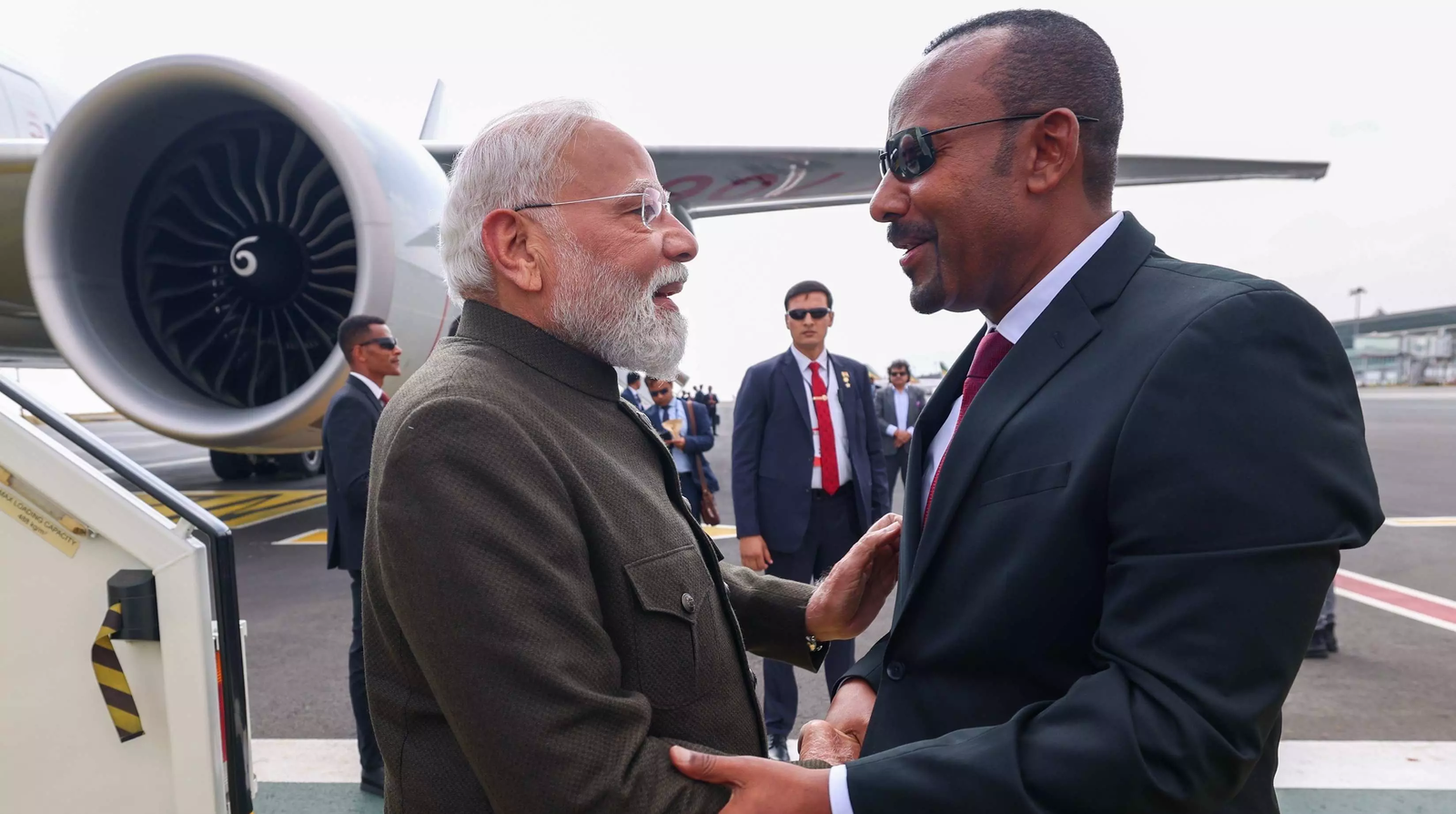
Modi in Ethiopia: Turning Warm Optics into Strategy
Prime Minister Narendra Modi’s two-day visit to Ethiopia marked a moment of rare diplomatic symbolism and strategic intent. Beginning on December 17, 2025, the visit opened with an extraordinary personal gesture by Ethiopian Prime Minister Abiy Ahmed, who himself drove Modi from Addis Ababa’s Bole International Airport to his hotel. Departing from formal protocol, Abiy Ahmed took his guest on an informal tour of the Science Museum and Friendship Park—sites that reflect Ethiopia’s developmental aspirations and the spirit of bilateral goodwill. The Indian diaspora’s emotional reception, complete with patriotic songs, further underscored the depth of people-to-people ties that frame this engagement.
Context and Purpose of the Visit
This visit holds historic significance as the first by an Indian Prime Minister to Ethiopia in over two decades, the last being Atal Bihari Vajpayee’s trip in 2002. Modi’s engagement is designed to recalibrate and elevate India–Ethiopia relations toward a comprehensive strategic partnership. Beyond ceremonial warmth, the visit is anchored in concrete objectives: expanding defense cooperation, strengthening digital connectivity, boosting agricultural collaboration, and significantly enhancing trade and investment flows. Ethiopia, one of Africa’s fastest-growing economies and a political anchor in the Horn of Africa, represents a critical partner in India’s broader Africa and Global South outreach.
Political and Strategic Impact
Politically, the visit reinforces India’s growing engagement with Africa at a time when global power balances are shifting. Ethiopia’s influence within the African Union and its voice in multilateral platforms such as the G20 make it a valuable diplomatic ally. Modi’s outreach seeks Ethiopia’s backing for India’s long-standing aspirations, including a permanent seat on the UN Security Council and membership in the Nuclear Suppliers Group. The warmth displayed by Abiy Ahmed signals Addis Ababa’s openness to championing India’s cause within African and Global South forums.
Strategically, the engagement aligns India more firmly with the Horn of Africa, a region critical to Red Sea shipping lanes and Indian Ocean security. Enhanced defense cooperation—including joint production and maritime security collaboration—supports India’s SAGAR (Security and Growth for All in the Region) doctrine while balancing the expanding footprint of other global powers in the region.
Strengthening Economic and Developmental Ties
Economically, the visit aims to unlock the next phase of India–Ethiopia trade and investment. Bilateral trade currently stands at approximately $1.3 billion, with both sides targeting a significant expansion through preferential market access for Ethiopian exports and greater Indian investment in industrial parks. Cooperation in digital public infrastructure, including the potential expansion of India’s UPI model, positions India as a development partner rather than merely a commercial actor.
Agriculture, pharmaceuticals, renewable energy, and logistics—particularly through connectivity linked to India-backed corridors—form the backbone of proposed cooperation. These initiatives align with Ethiopia’s post-conflict economic rebuilding and India’s ambition to become Africa’s long-term development partner.
Beyond Optics to Enduring Partnership
Prime Minister Modi’s Ethiopia visit blends symbolism with strategy, projecting India as a confident, reliable partner in Africa’s future. While challenges remain—including Ethiopia’s internal political complexities—the visit lays the groundwork for a deeper, more resilient partnership. By combining diplomatic warmth, economic pragmatism, and geopolitical clarity, India positions itself not just as an observer but as a stakeholder in Africa’s rise. If sustained through implementation, this engagement could become a defining chapter in India’s evolving Global South leadership narrative.