AI Agents, Semantic Intelligence, and Unified Data Platforms Emerge as Core Drivers of Future-Ready Enterprises
SYDNEY, Australia — More than one in ten enterprises will operate as "AI-first" organizations by 2030, outperforming competitors through advanced adoption of AI agents, semantic intelligence, and converged data and analytics (D&A) platforms, according to Gartner, Inc. These three pillars represent the driving forces behind the top trends shaping the industry's next phase.
"Organizations are moving rapidly toward an AI-first operating model, where AI is now a core consideration in every business decision, workflow and investment," said Carlie Idoine, VP Analyst at Gartner. Without a clear, enterprise-wide commitment, she noted, organizations will struggle to consistently realize AI's full potential across the business.
Gartner recommends that organizations factor the following six trends into their strategic planning over the next two years.
Trend 1: Sovereign AI Accelerates. As AI becomes central to national economic strength, governments are increasingly prioritizing control over their own AI capabilities, reducing dependence on foreign providers. Localizing D&A infrastructure has become a geopolitical necessity rather than a discretionary choice, forcing organizations to factor sovereign AI considerations directly into their roadmaps.
Trend 2: Reducing AI Agent Risk with Decision Governance. As AI agents take on more strategic and operational decision-making, ungoverned automation increases legal, operational, and reputational exposure. Gartner predicts that explicitly governed business decisions will be five times more trusted and 80% faster than ungoverned ones by 2029.
Trend 3: Driving Trust with AI Governance Platforms. Conventional assurance methods can no longer keep pace with rising regulatory complexity and the rapid spread of autonomous AI agents. Centralized governance platforms are becoming essential for enforcing responsible AI principles consistently across the enterprise.
Trend 4: Agentic Data Streaming Powers Real-Time Intelligence. Traditional batch processing is too slow to support AI agents effectively. Gartner projects that adoption of real-time data streaming for agentic AI will surge past 60% by 2028, up sharply from under 15% in 2025.
Trend 5: Streamlining Operations with Agentic Data Management. AI agents are increasingly being deployed to manage complex data environments directly, enabling real-time pattern detection and adaptive responses—provided organizations maintain strong governance and continuous performance monitoring.
Trend 6: Handling Complex Use Cases with GraphRAG. Traditional retrieval-augmented generation struggles with complex, context-rich queries. By combining knowledge graphs with large language models, GraphRAG improves contextual accuracy, with Gartner predicting 40% of enterprises will adopt the technique by 2029.
FaceOff's Homegrown Multimodal AI: A PQC-Powered Response
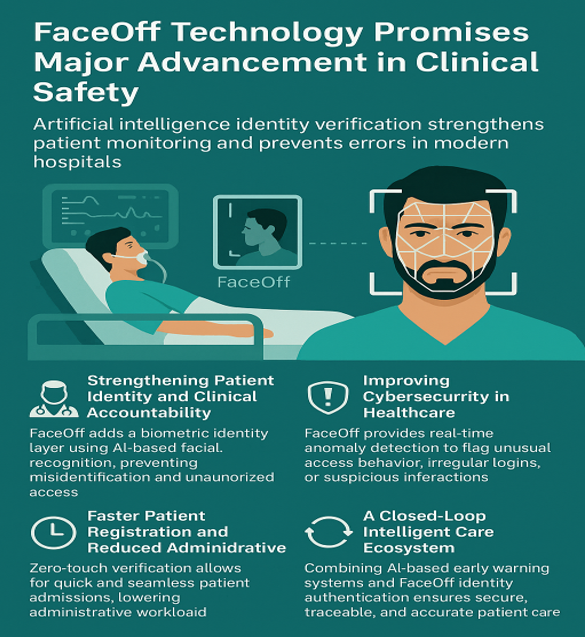
Against this backdrop, FaceOff Technologies has built a homegrown, multimodal AI stack designed to address several of these trends simultaneously, rather than treating sovereignty, governance, and real-time intelligence as separate problems. At its core sits the Adaptive Cognito Engine (ACE), a proprietary multimodal system that analyzes facial micro-expressions, gaze patterns, voice sentiment, physiological indicators, and behavioral biometrics to generate real-time Digital Trust Scores. Because the underlying LLM and detection models are built in-house rather than rented from foreign hyperscale labs, FaceOff directly answers the sovereign AI imperative Gartner outlines—offering enterprises and government bodies a model they fully own, control, and can audit, insulating critical identity-verification infrastructure from external dependency or disruption.
Layered onto this foundation is Post-Quantum Cryptography (PQC), embedding cryptographic provenance and authenticity markers into digital content that remain verifiable even against future quantum-computing attacks. Combined with a human-in-the-loop design at high-stakes decision points, this gives FaceOff's architecture a governance dimension that aligns closely with Gartner's emphasis on explainable, auditable decision-making: critical legal, financial, and reputational verdicts are never left to automation alone, but are informed by real-time, quantum-resilient evidence and adjudicated by humans. In effect, FaceOff is positioning itself not merely as a deepfake-detection tool, but as sovereign, future-proofed trust infrastructure built for the AI-first enterprise era Gartner describes.