


A fresh advisory issued by the National Cybercrime Threat Analytics Unit (NCTAU) under the Indian Cyber Crime Coordination Centre (I4C), Ministry of Home Affairs, has confirmed what the industry has quietly grappled with for some time: cybercriminals are increasingly deploying AI-powered tools to create realistic deepfake videos and synthetic identities to gain unauthorised access to financial and digital services, with these technologies being used to circumvent facial authentication systems, liveness verification checks, video KYC processes and account recovery mechanisms.
The verification checkpoints that banks and fintechs have relied on for years — facial authentication, liveness detection, and Video-KYC — were built on a simple assumption: a face on screen means a real, present human. That assumption no longer holds. The advisory describes how fraudsters gather facial data through deceptive video calls, fake online job interviews, or social engineering tactics, then process these recordings using AI-powered deepfake technologies. The attack often begins with an approach through social media platforms, messaging apps, job portals, dating applications, or direct phone calls, after which victims are manipulated into performing specific facial actions such as looking into the camera, turning their heads, blinking, or speaking — footage that is then weaponised.
This isn't a future risk — it's happening now, at the exact onboarding and authentication moments institutions have treated as their strongest line of defence. And once a synthetic identity or deepfake-backed account clears KYC, it doesn't behave like typical fraud. It often passes cleanly, sits dormant, and only activates later — moving funds across a chain of connected accounts in a single coordinated burst. The advisory's strongest recommendation to citizens is that locking one's biometric profile is the most effective defence against this type of remote identity theft.
With India processing billions of digital transactions monthly through UPI, and an increasing share of customer onboarding happening remotely, identity verification has become the single most targeted layer in the stack — and the one most urgently in need of rethinking.
FaceOff Technologies Complements the Solution:
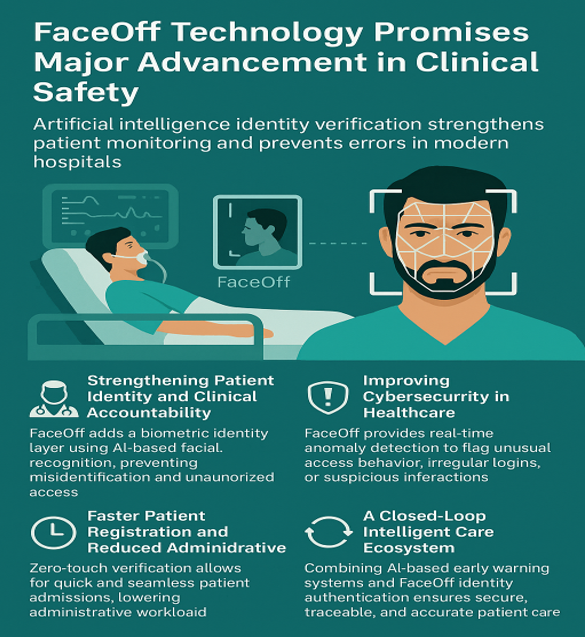
This is precisely the gap FaceOff Technologies' platform is engineered to close. Where traditional Video-KYC assumes "a face equals a real human," FaceOff's Adaptive Cognito Engine (ACE) treats that assumption as the attack surface itself — fusing real-time deepfake detection, passive liveness verification, behavioral biometrics, and document authentication into a single trust score.
Specifically, FaceOff addresses each vector flagged in the MHA advisory:
In effect, FaceOff shifts the model from "verify once at onboarding" to continuous trust verification across video, audio, document, and behavioral channels — directly responding to the NCTAU's core warning that static, single-point identity checks are no longer sufficient against AI-driven impersonation at scale.