
Attack Surface & Exposure Management
Continuously map internet-facing domain assets, discovering uncatalogued development subdomains, testing servers, and exposed cloud services before adversaries locate them.
How the sector deploys itExamine publicly available domain, DNS and subdomain information to understand internet-facing digital infrastructure: discover subdomains, analyse zone records, map related domain assets, and maintain structured inventories for attack-surface management and authorised security assessments.
Where it looks
Interface simulation: an illustration of the workflow, not a live analysis
What it is
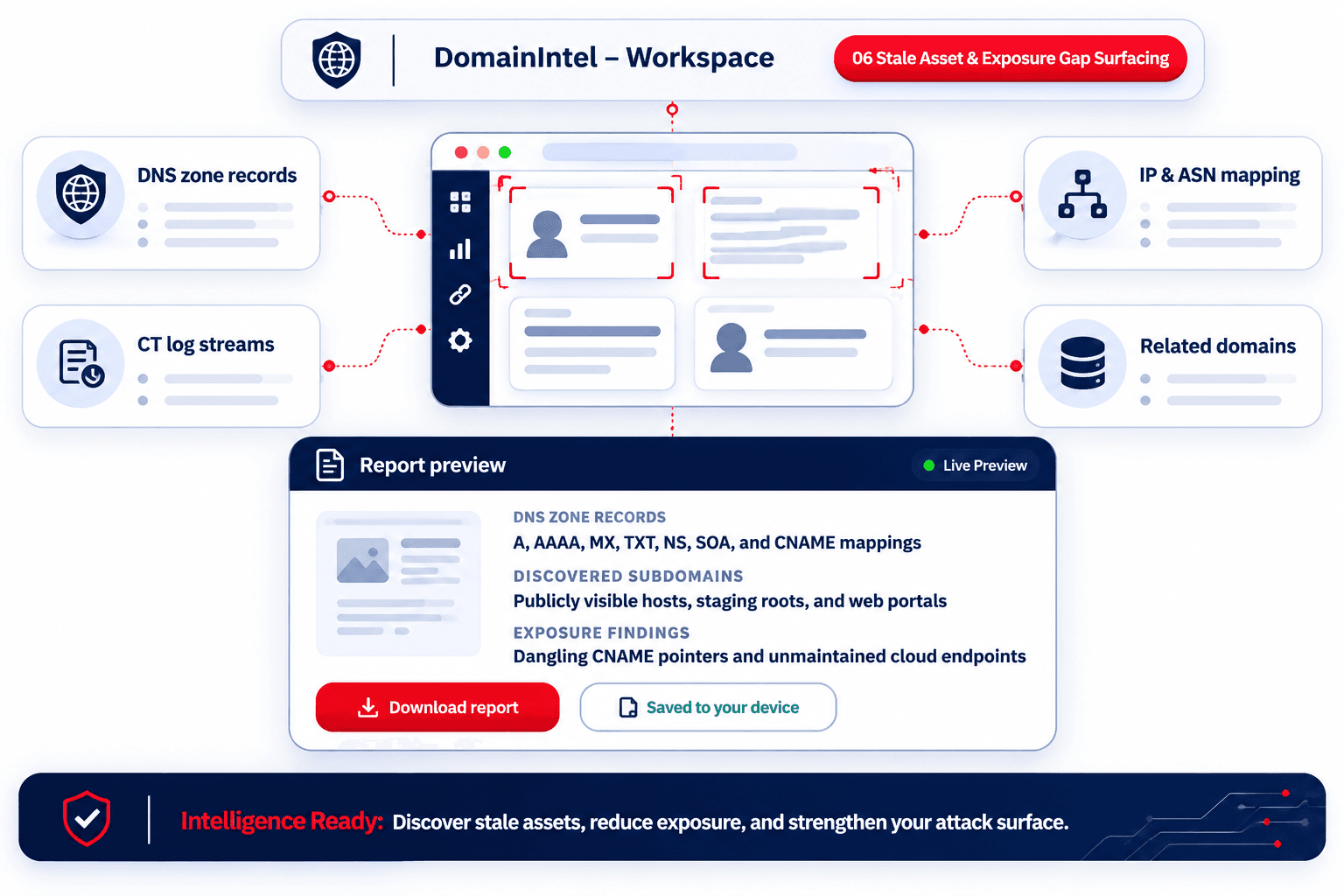
DomainIntel delivers domain intelligence by examining publicly available domain, DNS and subdomain information to help teams understand internet-facing digital infrastructure. It can assist with identifying subdomains, reviewing DNS records and mapping related domain assets, providing valuable context for attack-surface management, asset inventory, threat research and authorised security assessments.
A clearer view of domain relationships can help organisations identify forgotten or unexpected assets, investigate infrastructure changes and prioritise further validation. DomainIntel’s importance is its ability to turn dispersed technical records into an organised picture of a domain’s observable footprint.
Typical capabilities include DNS record analysis, subdomain discovery, domain relationship mapping and structured asset reporting, using passive and otherwise authorised sources wherever possible to provide dependable visibility without invasive network probing.
Key capabilities include DNS record analysis, subdomain and related-domain discovery, and visibility into publicly observable domain assets.
DNS records
Inspects A, AAAA, MX, TXT, NS, SOA, and CNAME zone records from open authoritative resolvers
Subdomain discovery
Enumerates publicly observable subdomains, hosts and service endpoints without active intrusion
Asset mapping
Turns dispersed technical records into an organized picture of a domain's observable infrastructure
Passive OSINT
Operates using passive and authorised sources to protect operational discretion and server availability
Interactive Domain Topology
Simulate multi-resolver DNS harvesting, passive Certificate Transparency streaming, and zone exposure checks.
Passive DNS record harvesting, subdomain mapping and attack-surface exposure identification.
Passive infrastructure topology · Click any subdomain node to inspect DNS records & exposures
API Record · AS13335 (Cloudflare, US)
Primary production API gateway endpoint; responsive HTTP 200.
Discovered from open DNS resolvers and public Certificate Transparency logs without active vulnerability probing or network intrusion.
How it works
Specify target apex domains, wildcard boundaries, and passive discovery policies
Query public root resolvers for A, AAAA, MX, NS, SOA, and TXT verification records
Aggregate subdomains from Certificate Transparency logs, public zone data, and web indexes
Map discovered hostnames to IP allocations, ASN designations, and hosting networks
Surface shared mail servers, name server clusters, CNAME aliases, and affiliate assets
Highlight orphaned subdomains, dangling CNAME pointers, and unmaintained test endpoints
Synthesise normalized zone maps, asset inventories, and audit trails for security review
Interface simulation: an illustration of the workflow, not a live analysis
Specify target apex domains, wildcard boundaries, and passive discovery policies
Query public root resolvers for A, AAAA, MX, NS, SOA, and TXT verification records
Aggregate subdomains from Certificate Transparency logs, public zone data, and web indexes
Map discovered hostnames to IP allocations, ASN designations, and hosting networks
Surface shared mail servers, name server clusters, CNAME aliases, and affiliate assets
Highlight orphaned subdomains, dangling CNAME pointers, and unmaintained test endpoints
Synthesise normalized zone maps, asset inventories, and audit trails for security review
Capabilities
Replace piecemeal CLI lookups and ad-hoc scripts with systematic, passive infrastructure reconnaissance.
DNS record analysis
Interface simulation: an illustration of the workflow, not a live analysis
Comparison
Why structured domain intelligence, passive discovery, and relationship mapping surpass disconnected DNS scripts.
Comprehensive DNS zone harvesting
Passive subdomain enumeration
Domain relationship & asset clustering
Dangling CNAME & orphan detection
Non-intrusive passive OSINT
Target query confidentiality
The architecture
Multi-resolver DNS harvesting, passive Certificate Transparency streaming, and sovereign asset synthesis
Apex namespace definition, root nameservers & passive discovery boundaries
Infrastructure Correlation Core
Aggregates DNS zone hierarchies, maps subdomains to hosting IPs, and detects dangling CNAMEs
Strictly lawful OSINT from publicly accessible sources. Domain targets, DNS zone snapshots, and infrastructure asset dossiers remain entirely within your sovereign environment.
Unified, topological view of discovered hostnames, routing paths and cloud services
Audit-ready asset inventories with full zone provenance, timestamps and risk notes
Measured capabilities
100% Passive sources
Discovers infrastructure via public DNS, Certificate Transparency and zone registries without noisy network sweeps
Thousands of hosts
Rapidly enumerates large enterprise subdomain estates and complex multi-region cloud routing topographies
Zero server strain
Queries public root and authoritative resolvers without sending intrusive packets to target production hosts
Sovereign isolation
Target domains, discovered asset maps, and vulnerability notes remain strictly confined to your environment
DomainIntel is engineered for security, research and attack-surface management teams who need complete visibility of observable domain infrastructure while upholding operational discretion.
Sectors
Continuously map internet-facing domain assets, discovering uncatalogued development subdomains, testing servers, and exposed cloud services before adversaries locate them.
How the sector deploys itIdentify newly registered lookalike domains, suspicious DNS variations, and unauthorized brand uses intended for spear-phishing campaigns or credential harvesting.
Quickly assess the external digital estate and technical health of acquisition targets, mapping acquired domain portfolios, cloud dependencies, and legacy servers.
How the sector deploys itUnravel attacker command-and-control infrastructure by mapping shared name servers, historical IP allocations, and co-hosted malicious domains.
How the sector deploys itDeployment
Designed for immediate deployment with zero exposure of sensitive investigation targets.
01 · Define apex domain scopes and discovery boundaries
Interface simulation: an illustration of the workflow, not a live analysis
DomainIntel operates strictly through passive DNS aggregation, public zone inspections and open Certificate Transparency feeds without launching active scans or intrusive probes against target infrastructure.
The principle
Moving from piecemeal terminal queries to structured, lawful and defensible infrastructure intelligence.
Frequently asked questions
Everything you need to know about sources, passive discovery, privacy and lawful operation.
DomainIntel is a domain and DNS intelligence solution that examines publicly available domain, DNS, and subdomain information to help security and research teams understand internet-facing digital infrastructure, catalogue exposed assets, and manage attack surfaces.
No. DomainIntel operates passively. It collects intelligence from authoritative DNS resolvers, Certificate Transparency logs, public zone registries, and open records without sending intrusive connection probes or running vulnerability scans against target hosts.
DomainIntel monitors public Certificate Transparency (CT) log streams, queries open DNS datasets, evaluates historic zone changes, and correlates cross-domain references, discovering subdomains without brute-force packet floods.
Yes. DomainIntel flags CNAME records that point to non-responsive cloud storage buckets, decommissioned hosting providers, or expired SaaS platform services, alerting teams to potential takeover risks.
When installed on premises or within your private cloud, all target seeds, discovered subdomain inventories, and audit logs remain strictly within your sovereign environment. Nothing is shared with external scraper APIs.
DomainIntel exports structured asset inventories in JSON and CSV formats, including DNS record types, resolved IP addresses, ASN designations, certificate issuers, and timestamped discovery trails for audit compliance.
The rest of the line
See how DomainIntel helps attack-surface managers, threat researchers and security teams replace manual DNS lookups with structured infrastructure discovery.