
External Attack-Surface Management (EASM)
Continuously enumerate internet-facing IP blocks, cloud gateways, and open service ports to eliminate unknown or forgotten infrastructure exposures.
How the sector deploys itExamine publicly observable IP addresses, network ranges and internet-facing assets to build a clearer view of external exposure: identify exposed services, validate asset ownership, map network relationships, support attack-surface management and prioritise defensive action within explicitly authorised scope.
Where it looks
Interface simulation: an illustration of the workflow, not a live analysis
What it is
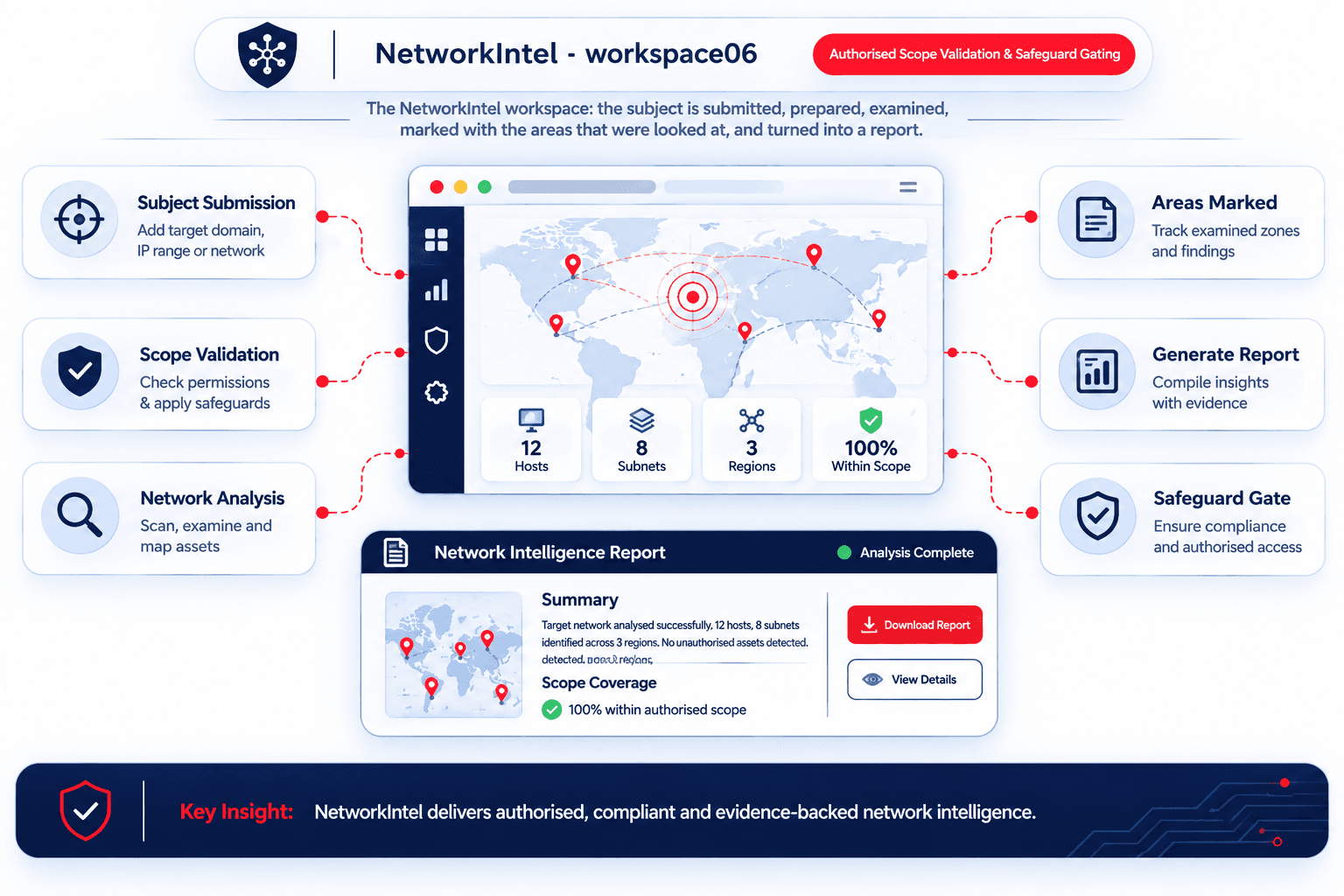
NetworkIntel helps organisations examine publicly observable IP addresses, network ranges and internet-facing assets to build a clearer view of their external exposure. By bringing together relevant network and asset information, it can support attack-surface management, infrastructure inventory, threat intelligence and authorised security assessments.
Understanding which assets are visible from the internet is an important step in identifying unknown services, validating ownership and prioritising defensive action. NetworkIntel is designed to make network information easier to interpret and investigate, helping security teams move from scattered technical indicators to a more organised picture of their external environment.
Capabilities may include IP and network analysis, exposed-asset discovery, relationship mapping and structured findings; discovery results should be validated and testing must remain within explicitly authorised scope.
Key capabilities include IP address and network-range analysis, discovery of publicly exposed assets, and external attack-surface visibility and reporting.
Public IP ranges
Discovers and evaluates internet-facing IPv4/IPv6 addresses, BGP routing prefixes and Autonomous Systems
Exposed assets
Identifies open services, protocol banners, TLS certificates and unexpected digital infrastructure
Attack surface
Maps network asset relationships and flags dangling endpoints, orphaned hosts and exposure risks
Authorised scope
Maintains disciplined discovery boundaries; testing and active validation remain strictly within authorised scope
How it works
Specify target IP ranges, CIDR subnets, ASN prefixes, or organisation domains in scope
Enumerate autonomous systems, prefix announcements, and global network routing tables
Correlate historical DNS PTR records, Certificate Transparency logs, and active host nodes
Examine publicly observable open ports, protocol banners, and TLS handshake certificates
Attribute cloud host clusters, staging endpoints, shadow services, and hosting providers
Enforce strict boundaries ensuring all scanning and analysis remain within approved scope
Synthesise normalised asset inventories, exposure flags, and audit-compliant case reports
Interface simulation: an illustration of the workflow, not a live analysis
Specify target IP ranges, CIDR subnets, ASN prefixes, or organisation domains in scope
Enumerate autonomous systems, prefix announcements, and global network routing tables
Correlate historical DNS PTR records, Certificate Transparency logs, and active host nodes
Examine publicly observable open ports, protocol banners, and TLS handshake certificates
Attribute cloud host clusters, staging endpoints, shadow services, and hosting providers
Enforce strict boundaries ensuring all scanning and analysis remain within approved scope
Synthesise normalised asset inventories, exposure flags, and audit-compliant case reports
Capabilities
Replace scattered port scans with systematic, context-aware network asset and attack-surface intelligence.
IP address and CIDR network-range analysis
Interface simulation: an illustration of the workflow, not a live analysis
Comparison
Why structured network intelligence beats uncoordinated point scanners and manual terminal probing.
Multi-prefix BGP & CIDR range discovery
Passive asset & service discovery
Attack-surface dependency & topology mapping
Strict authorised scope enforcement
Public-only non-invasive OSINT compliance
Sovereign private deployment & query secrecy
Structured audit trail & JSON / CSV export
The architecture
BGP prefix mapping, passive DNS correlation, and sovereign attack-surface inventory
Identifies target CIDR subnets, autonomous system numbers (ASNs), or internet-facing network perimeters in scope
Normalizes IP subnets, aggregates routing announcements, fingerprints open ports, and correlates attack-surface dependencies
Strictly lawful OSINT from publicly observable internet-facing assets. Network scans, IP queries, and attack-surface dossiers remain entirely within your sovereign environment. Active testing and vulnerability validation must remain within explicitly authorised scope.
Cartographic and topological view of resolved IP nodes, exposed services, and routing pathways
Audit-ready technical inventories with CIDR allocations, service banners, and exposure findings
Measured capabilities
Global BGP visibility
Monitors observable routing prefixes and peering relationships across thousands of Autonomous Systems
100% Non-invasive
Operates primarily on passive, publicly observable telemetry and authorised inspection protocols
Minutes per prefix
Replaces days of ad-hoc manual IP pinging and DNS brute forcing with instant topology aggregation
Zero target leakage
Network investigation scopes, asset inventories, and exposure dossiers remain inside your private boundary
NetworkIntel is built for authorized attack-surface management, infrastructure inventory and security reviews; discovery results should be verified and testing must remain within explicitly authorised scope.
Sectors
Continuously enumerate internet-facing IP blocks, cloud gateways, and open service ports to eliminate unknown or forgotten infrastructure exposures.
How the sector deploys itRapidly identify which corporate assets correspond to suspicious IP indicators, compromised prefixes, or rogue infrastructure during active inquiries.
How the sector deploys itDiscover the true internet-facing technical perimeter of acquisition targets and third-party vendors without intrusive active scanning.
How the sector deploys itValidate that sensitive operational networks and management interfaces remain completely segregated from publicly routable network ranges.
How the sector deploys itDeployment
Designed for rapid adoption with zero leakage of sensitive network investigation targets.
01 · Define network scope and compliance parameters
Interface simulation: an illustration of the workflow, not a live analysis
The principle
Moving from fragmented IP lists to structured, defensible and context-rich attack-surface management.
NetworkIntel is FaceOff's IP address, network and exposed asset intelligence solution within TrustShield OSINT. It helps organisations examine publicly observable IP addresses, network ranges and internet-facing assets to build a clear view of their external exposure.
No. NetworkIntel focuses on discovering and evaluating publicly observable infrastructure through passive telemetry, DNS routing analysis, and courteous protocol banner inspection. Testing remains strictly within explicitly authorised scope.
Yes. By correlating BGP prefix announcements, autonomous systems, TLS certificate subject alternative names, and DNS records, NetworkIntel uncovers unmanaged cloud instances, staging gateways, and forgotten subnets.
When deployed on premises or within your private VPC, all network queries, IP inventories, and attack-surface dossiers remain strictly within your sovereign environment. No target ranges or query terms are shared with third-party vendors.
NetworkIntel analyzes IPv4 and IPv6 addresses, CIDR network allocations, BGP routing tables, ASN peerings, reverse DNS (PTR) records, open TCP/UDP service banners, and TLS handshake certificates.
NetworkIntel exports structured attack-surface dossiers in JSON, CSV, and PDF formats, with full IP attributes, service metadata, timestamped findings, and audit logs suitable for executive reporting and technical remediation.
The rest of the line
See how NetworkIntel helps security, infrastructure and due diligence teams replace scattered network tools with structured external attack-surface intelligence.