
Fraud & Trust Teams
Rapidly checks email domain age, associated online profiles, and historic web presence to detect synthetic identities and account takeover attempts at onboarding.
How the sector deploys itDiscover publicly accessible accounts and information associated with an email address across online platforms: correlate public profiles, support digital identity research and fraud reviews, and consolidate verified leads for authorised investigations while preserving strict analytical boundaries.
Where it searches
Interface simulation: an illustration of the workflow, not a live analysis
What it is
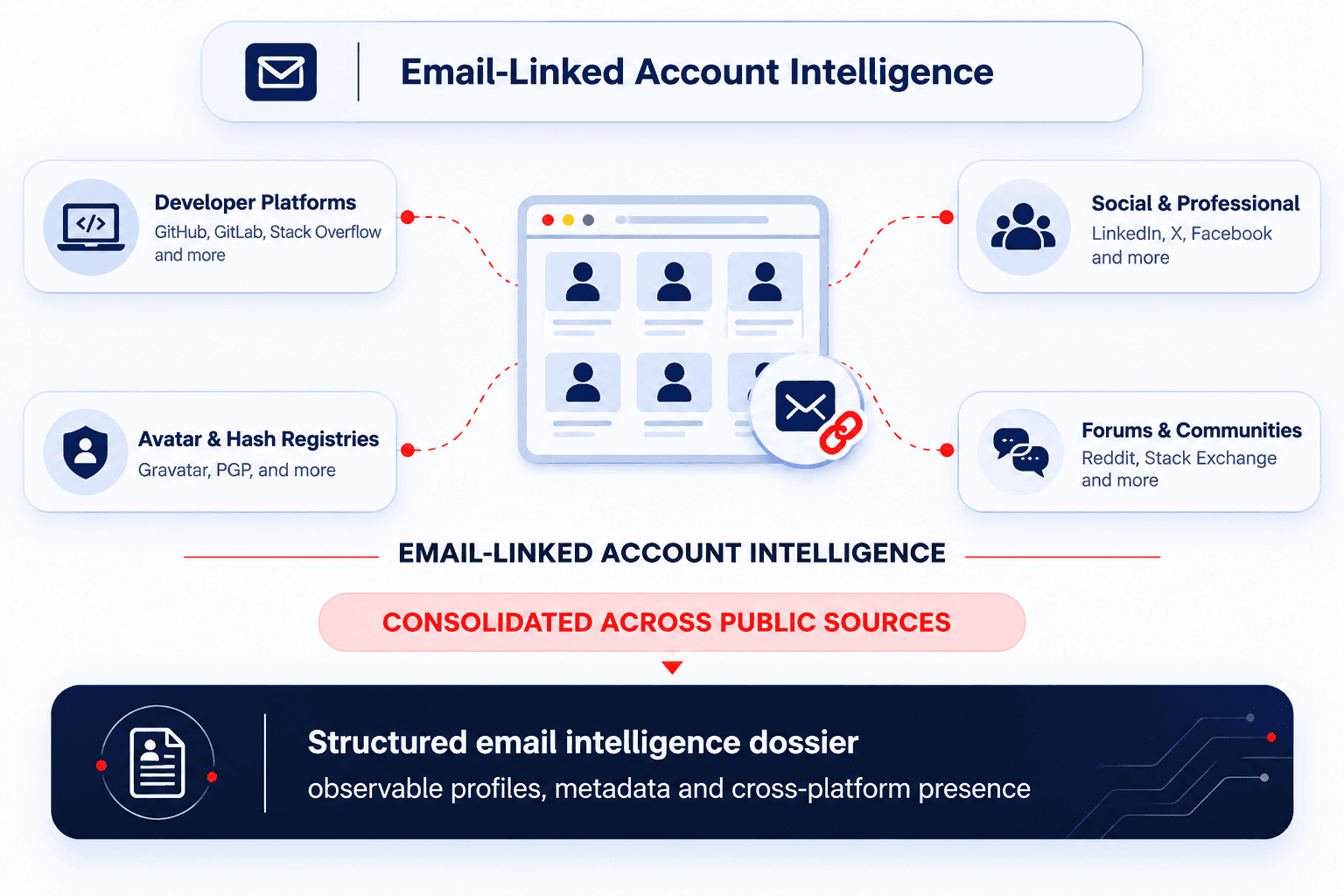
EmailIntel helps investigators discover publicly accessible accounts and information associated with an email address. By checking relevant public sources and organising possible matches, the solution can support account discovery, digital identity research, fraud review and authorised security investigations.
Email addresses are frequently used as account identifiers, so carefully correlating public results can provide useful leads about an online presence and help analysts decide what requires further verification. EmailIntel is valuable because it can streamline a time-consuming research process and present findings in a consistent format.
Capabilities include email-based account searches, associated profile discovery and result consolidation. Matches must be independently validated, since shared, recycled or mistyped email addresses can produce misleading associations; findings are presented with full evidence context for analyst determination.
Key capabilities include discovery of accounts exposed in public sources, organisation of possible email-linked profiles, and consolidated results for verification.
Public sources
Discovers accounts and presence exposed across open online platforms and public registrations
Email linkage
Surfaces potential profile matches, public activity and account handles tied to the address
Consolidated format
Replaces repetitive manual search steps with structured, consistent analyst dossier views
Analyst validated
Treats matches as investigatory leads; independent validation required for shared or recycled emails
Interactive Discovery Graph
Simulate multi-source query fan-out across developer platforms, professional directories, and public avatar hash registries.
Multi-source public query fan-out correlating email addresses to public online profiles.
Interactive multi-vector graph · Select any node to inspect public correlation evidence
Code & Open Source
“Systems security researcher at Cipher Labs. Rust & Go contributor.”
Public Git commit author-email header directly matches seed address.
A matching email is treated as an inquiry lead rather than proof of identity. Shared corporate aliases, mistyped submissions, or recycled domains require analyst verification.
How it works
Provide the target email identifier in scope for authorised review
Verify RFC compliance, MX records, domain reputation and mail provider type
Probe open services, developer registries, community forums and public endpoints
Harvest publicly visible profiles, handles, public avatars and observable bios
Correlate discovered accounts against domain context, activity patterns and names
Flag recycled mailboxes, common aliases and shared organizational inboxes
Synthesise verified findings, timestamped source links and audit logs for analysts
Interface simulation: an illustration of the workflow, not a live analysis
Provide the target email identifier in scope for authorised review
Verify RFC compliance, MX records, domain reputation and mail provider type
Probe open services, developer registries, community forums and public endpoints
Harvest publicly visible profiles, handles, public avatars and observable bios
Correlate discovered accounts against domain context, activity patterns and names
Flag recycled mailboxes, common aliases and shared organizational inboxes
Synthesise verified findings, timestamped source links and audit logs for analysts
What sets it apart
Replace fragmented, repetitive manual lookups with disciplined, multi-source public account correlation.
Discovery of accounts exposed in public sources
Interface simulation: an illustration of the workflow, not a live analysis
Method comparison
Why structured email intelligence, correlation reasoning, and safeguard boundaries surpass manual tab hunting.
Multi-platform presence fan-out
Consolidated profile organisation
Collision & recycling safeguards
Public-only non-invasive OSINT
Investigation audit trail
Target query confidentiality
The architecture
Multi-vector presence queries, domain validation, avatar hash correlation, and sovereign case synthesis
Domain syntax validation, mail exchanger check & scope configuration
Email Correlation & Gating Core
Correlates public profiles, evaluates confidence signals and flags homonyms or shared inboxes
Strictly lawful OSINT from publicly accessible sources. Email inquiry parameters, correlation leads, and dossier records stay entirely within your sovereign environment.
Unified, interactive view of discovered accounts, match signals and confidence ratings
Traceable evidence records with direct source URLs, timestamps and analyst notes
Measured capabilities
100+ Platforms
Checks email-associated account presence across open developer, professional, community and public services
100% Public data
Exclusively queries publicly observable sources without password probing, login bypass or private breach hunting
Seconds per query
Replaces hours of repetitive individual platform lookups with immediate, synchronized lead consolidation
Zero query leakage
Target email inquiries and case files never leave your sovereign deployment boundary or train public models
EmailIntel is intended for lawful, ethical use of publicly available information; a matching email should be treated as an inquiry lead rather than proof that accounts belong to the same person.
Use cases by sector
Rapidly checks email domain age, associated online profiles, and historic web presence to detect synthetic identities and account takeover attempts at onboarding.
How the sector deploys itConsolidates publicly discoverable profiles and digital traces connected to an address, establishing contextual background during corporate and vendor reviews.
How the sector deploys itProduces timestamped, audit-compliant dossier records with direct source URLs and exact correlation notes to support lawful cyber investigations.
How the sector deploys itMaps connected public handles, forums, and registries to uncover infrastructure and operational footprints behind impersonation or phishing campaigns.
Deployment strategy
Engineered for rapid adoption with zero leakage of sensitive investigation queries.
01 · Define email inquiry scopes and compliance boundaries
Interface simulation: an illustration of the workflow, not a live analysis
EmailIntel operates exclusively on publicly accessible data and does not bypass private gates or attempt authentication cracking.
What it has to get right
Moving from time-consuming manual lookups to structured, lawful and defensible email discovery.
No. A matching email should strictly be treated as an investigative lead rather than conclusive proof. Email addresses can be recycled by domain registrars, mistyped during registration, or shared across teams (such as corporate role inboxes). Analysts must examine contextual indicators, activity timelines, and secondary corroborating evidence before drawing conclusions.
EmailIntel checks publicly accessible sources, including open developer registries, community platforms, public profile directories, public avatar registries (e.g. Gravatar), and open metadata feeds. It does not bypass login gates, access controls, or private account barriers.
No. EmailIntel conducts passive, non-intrusive public intelligence gathering. It checks publicly observable records, domain MX configurations and public endpoints without sending messages or triggering notifications to the target email inbox.
When deployed on-premise or within your private cloud, all queries, search seeds, discovered profiles, and case dossiers remain entirely within your sovereign boundary. No search seeds are logged by third-party scraper APIs or used to train external models.
Yes. EmailIntel evaluates the email domain against recognized temporary, disposable, and throwaway mail providers, alerting analysts when an address has an ephemeral lifespan.
Investigators can export findings into standardized, machine-readable JSON, CSV datasets, or formatted analyst case dossiers containing complete source links, timestamps, and confidence notes for chain of custody.
The rest of the line
See how EmailIntel helps fraud, intelligence and security teams replace manual searches with structured, defensible account discovery.