
Cybersecurity and attack surface reconnaissance
Catalogue public-facing domains, discover forgotten sub-pages or exposed files, and evaluate web infrastructure exposure for authorized vulnerability assessments.
How the sector deploys itDiscover, crawl and analyse websites, URLs and publicly accessible web content at scale: map site architecture, extract structured public data, and maintain clear records for research, reconnaissance and authorised security assessments while respecting robots directives and access controls.
Where it crawls
Interface simulation: an illustration of the workflow, not a live analysis
What it is
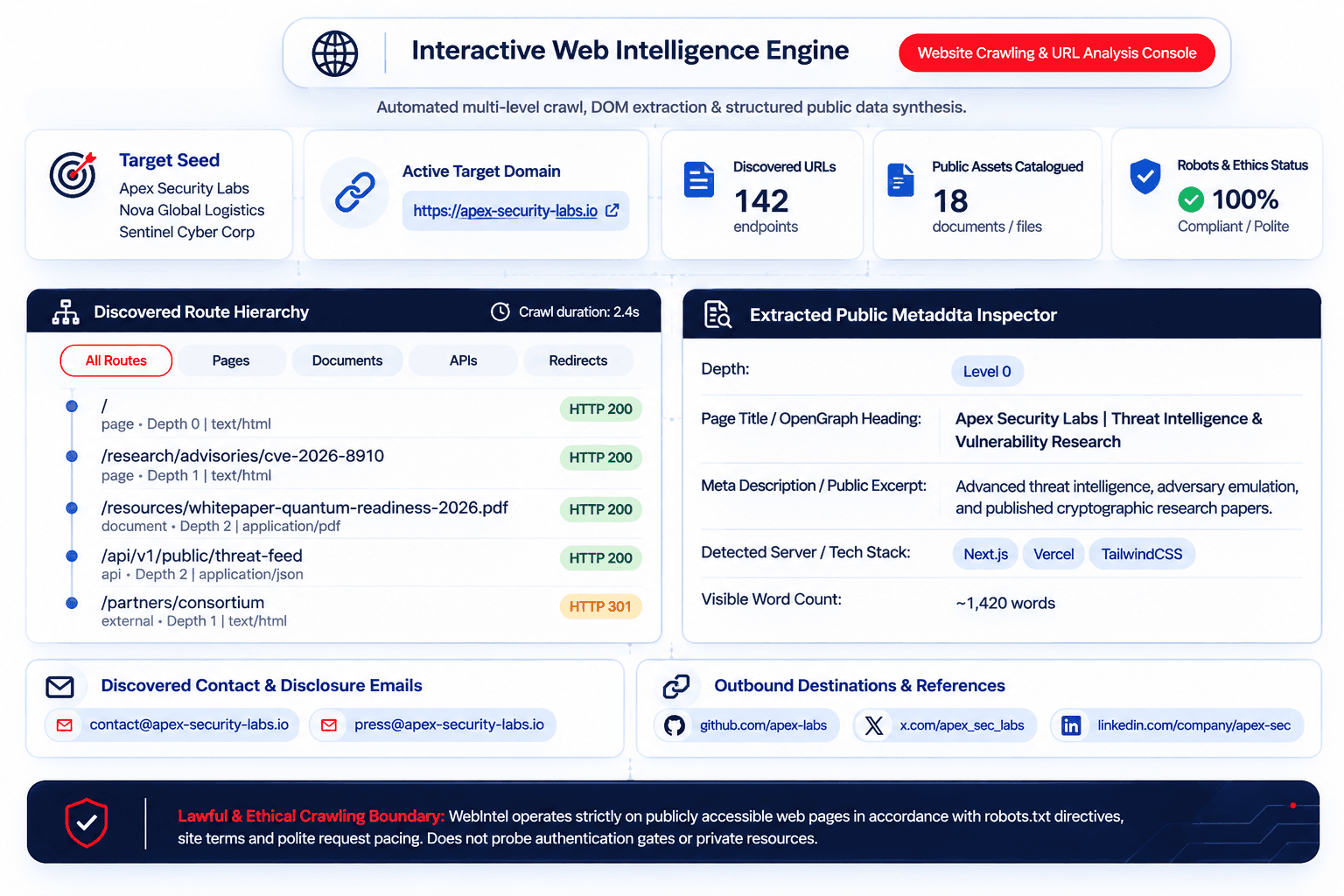
WebIntel is a web intelligence solution for discovering, crawling and analysing websites, URLs and publicly accessible web content. It can help research and security teams collect information from relevant pages, organise discovered URLs and extract useful public data at scale, making it easier to review a website’s visible content and structure.
This can support website reconnaissance, content monitoring, asset discovery, research and authorised security assessments. By reducing manual page-by-page inspection, WebIntel helps analysts focus on meaningful findings and maintain a clearer record of the sources reviewed.
Rather than clicking through hundreds of navigation links and manual browser tabs, analysts define target scopes and crawling policies once. WebIntel systematically traverses authorized routes, checks HTTP responses, extracts public DOM metadata, catalogues downloadable assets, and structures the findings into an organized investigation workspace.
Core capabilities include website crawling, URL collection, public content extraction and structured output; crawling respects applicable laws, website terms, access controls and robots directives.
Multi-level crawl
Discover, catalogue and map website hierarchy and link topology across public endpoints
Observable web
Exclusively gathers publicly accessible content without bypassing access gates or private controls
Structured formats
Extracts metadata, links, visible text and assets into normalised JSON, CSV and analyst dossiers
Sovereign control
Crawl configurations, target lists, extracted records and audit trails remain inside your boundary
How it works
Configure seed URLs, crawl depth limits, path inclusions and exclusion rules
Evaluate robots.txt, sitemaps, canonical tags and rate limits for compliant crawling
Non-invasive HTTP traversal with controlled request pacing and dynamic DOM support
Catalogue discovered internal routes, query parameters and external hyperlink destinations
Capture page titles, OpenGraph metadata, schema tags, public documents and visible text
Organize discovered endpoints into hierarchical trees and structured schema feeds
Evidence-ready review dashboard with CSV/JSON export and full crawl provenance
Interface simulation: an illustration of the workflow, not a live analysis
Configure seed URLs, crawl depth limits, path inclusions and exclusion rules
Evaluate robots.txt, sitemaps, canonical tags and rate limits for compliant crawling
Non-invasive HTTP traversal with controlled request pacing and dynamic DOM support
Catalogue discovered internal routes, query parameters and external hyperlink destinations
Capture page titles, OpenGraph metadata, schema tags, public documents and visible text
Organize discovered endpoints into hierarchical trees and structured schema feeds
Evidence-ready review dashboard with CSV/JSON export and full crawl provenance
What sets it apart
Website and URL discovery at scale
Interface simulation: an illustration of the workflow, not a live analysis
Method comparison
Multi-level URL discovery
Public content extraction
Robots & politeness controls
Dynamic DOM rendering
Public asset cataloguing
Investigation audit trail
Target query confidentiality
The architecture
Multi-level URL discovery, polite DOM parsing, asset extraction and sovereign evidence synthesis
Target domain parameters & politeness rate settings
Web Intelligence & Parsing Core
Transforms unstructured web pages and endpoints into organized, queryable intelligence
Strictly lawful crawling of publicly accessible web content. Crawling respects website terms, robots directives, and public access boundaries without private credential probe.
Interactive mapping of endpoints, status codes and response headers
Normalized JSON/CSV records, extracted public content and audit trail
Measured capabilities
Thousands of URLs/hr
Polite, multithreaded traversal across complex domain structures without server strain
100% Publicly accessible
Strictly collects open web data without bypassing login gates, paywalls or access controls
Structured formats
Exportable into normalized JSON, CSV, and audit-compliant case packages immediately
Zero private breach
Respects robots.txt directives and platform terms; intended for lawful, authorised review
WebIntel is engineered for research and security teams who need dependable, structured public web intelligence while maintaining rigorous adherence to legal standards and web politeness.
Use cases by sector
Catalogue public-facing domains, discover forgotten sub-pages or exposed files, and evaluate web infrastructure exposure for authorized vulnerability assessments.
How the sector deploys itCrawl e-commerce sites, third-party marketplaces and suspect web domains to identify brand infringement, fake product listings, or unauthorized distribution.
Systematically gather and review a target company’s public web estate, disclosures, published team rosters and corporate announcements to support background assessments.
How the sector deploys itAnalyse fraudulent clone sites, phishing landing pages, and illicit web networks, collecting structural evidence and linking shared templates or assets.
Monitor websites across regulated sectors for required public disclosures, mandatory legal terms, pricing transparencies and privacy policies.
Track published service offerings, pricing updates, technical documentation, and recruitment announcements across public corporate sites over time.
Gather verifiable, timestamped public web evidence from open online resources to support authorized cybercrime and intelligence inquiries.
How the sector deploys itDeployment strategy
01 · Define investigation scope & targets
Interface simulation: an illustration of the workflow, not a live analysis
WebIntel operates exclusively within public web boundaries. Crawl jobs adhere to website terms, access control barriers and robots directives, providing a defensible intelligence standard.
What it has to get right
Moving from manual page inspection to structured, lawful and defensible web intelligence.
WebIntel is a web intelligence solution designed to discover, crawl and analyse websites, URLs and publicly accessible web content. It helps research and security teams collect page data at scale, organise discovered URL hierarchies, and extract structured intelligence without manual page-by-page inspection.
No. WebIntel operates strictly on publicly accessible web pages and open endpoints. It does not attempt credential stuffing, authentication cracking, or access control bypasses.
WebIntel parses and respects robots.txt directives, observes canonical link tags, and enforces polite crawl rates to ensure target servers are never subjected to excessive load.
Yes. WebIntel features optional headless rendering support, enabling it to execute client-side scripts, evaluate dynamic single-page applications (SPAs), and extract observable DOM elements.
WebIntel captures page titles, headings, meta descriptions, OpenGraph tags, schema markup, outbound hyperlinks, internal route hierarchies, response headers, and visible body text stripped of boilerplate.
WebIntel deploys entirely within infrastructure your organisation controls—on premises or in your private cloud. Your target URLs, crawl parameters, and collected data never leave your environment.
Yes. WebIntel catalogues downloadable assets discovered during the crawl—such as PDFs, spreadsheets, media files, and document links—organizing them by MIME type and parent URL.
When conducted on publicly accessible information under applicable laws, site terms, and internal investigation mandates, public web crawling is a standard OSINT technique. WebIntel is built to uphold compliance by operating transparently, politely, and within lawful boundaries.
The rest of the line
See how WebIntel helps security, intelligence and research teams replace manual browsing with structured URL analysis and public content extraction.